


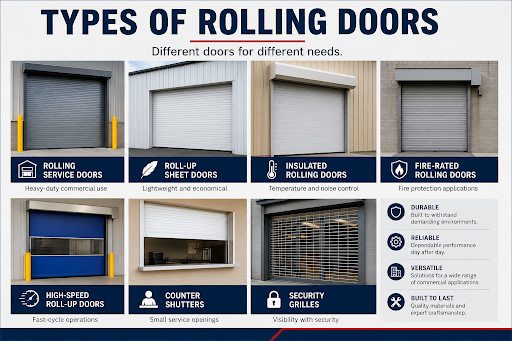
The main types of roll-up doors include rolling service doors, roll-up sheet doors, insulated rolling doors, fire-rated doors, high-speed doors, counter shutters, and security grilles.
Each one is built for a different job. A warehouse loading dock has different requirements than a concession stand or retail storefront.
Knowing the differences makes it easier to choose a door that fits the building and the way it is used.
- Rolling Service Doors – Heavy-duty commercial use
- Roll-Up Sheet Doors – Lightweight and economical
- Insulated Rolling Doors – Temperature and noise control
- Fire-Rated Rolling Doors – Fire protection applications
- High-Speed Roll-Up Doors – Fast-cycle operations
- Counter Shutters – Small service openings
- Security Grilles – Visibility with security
Also Read:
Pros and Cons of Roll Up Garage Doors
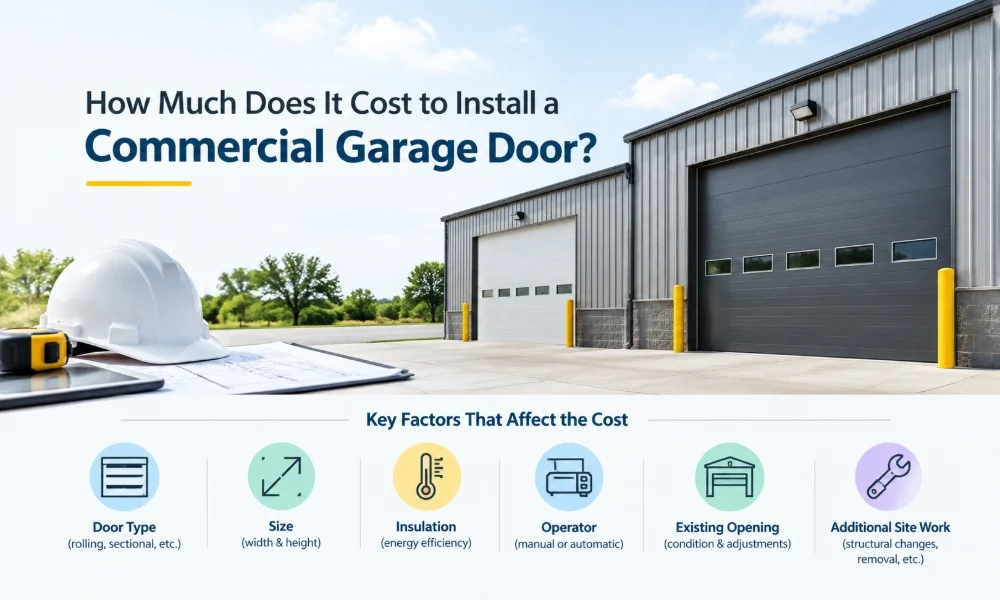
How Much Does It Cost to Install a Garage Door and Installation
How Roll-Up Doors Work
Roll-up doors open vertically and coil into a compact roll above the opening.
The curtain is made from slats or sheet steel and travels within guide tracks mounted on each side of the doorway.
As the door opens, it wraps around a drum located above the opening. This design requires less overhead space than many other door types.
It also keeps the door footprint compact, making roll-up systems common in warehouses, retail facilities, storage buildings, and industrial properties.
Rolling Service Doors (Standard Commercial Roll-Up Doors)
Among the various commercial roll-up doors available, rolling service doors are one of the most common choices for commercial and industrial buildings.
These doors use interlocking steel or aluminum slats that form a durable curtain, which is capable of handling frequent daily use.
You’ll often find them at Warehouses, distribution centers, manufacturing facilities, loading docks, and equipment storage buildings where durability matters more than appearance.
Roll-Up Sheet Doors
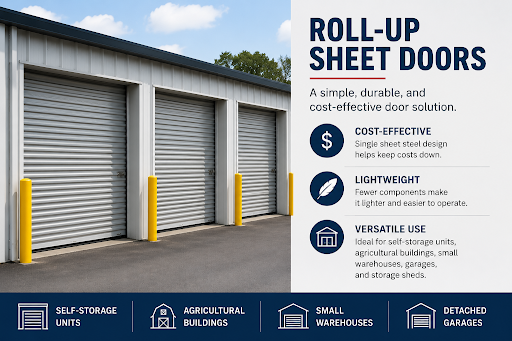
If you’ve seen the doors on a self-storage unit, you’ve probably seen a sheet door.
Instead of using many interlocking slats, the entire curtain is made from one corrugated sheet of steel. That simpler design keeps costs down and reduces the number of moving parts.
Sheet doors are generally lighter than rolling service doors because they use fewer components. They work well in locations where heavy-duty cycle performance is not required.
These doors are a practical option for self-storage units, agricultural buildings, small warehouses, detached garages, and storage sheds.
Insulated Rolling Doors
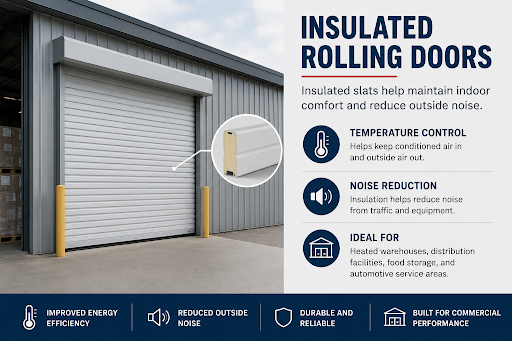
Some buildings need more than security. They also need help keeping conditioned air inside and reducing outside noise.
That’s where insulated rolling doors come in. Instead of standard single-layer construction, these doors use insulated slats that help limit heat transfer through the opening.
Facilities that often benefit from insulated doors include heated warehouses, distribution facilities, food storage buildings, and automotive service areas.
Insulation can help create a more stable indoor environment while also reducing noise from outdoor traffic and equipment. The exact insulation values vary by manufacturer and door design.
Fire-Rated Rolling Doors
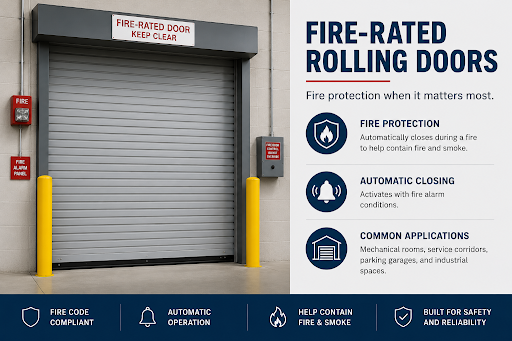
A standard rolling door can secure an opening, but it won’t necessarily meet fire code requirements.
Fire-rated rolling doors are built for locations where a fire-resistant barrier is required. If a fire is detected, the door can automatically close to help restrict it within a specific area of the building.
These doors are often used around mechanical rooms, service corridors, parking garages, and industrial spaces. Many fire-rated systems include automatic closing mechanisms that activate during certain fire alarm conditions.
High-Speed / High-Performance Roll-Up Doors
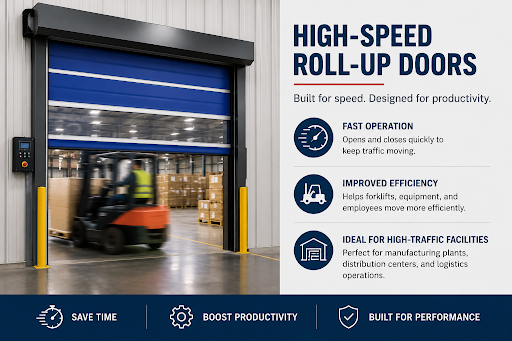
In a busy warehouse, waiting even a few extra seconds for a door to open can slow down traffic.
High-speed doors are designed for that kind of environment. They open and close much faster than a standard rolling door, helping forklifts, equipment, and employees move through openings more efficiently.
You’ll often find high-speed doors in manufacturing plants, distribution centers, and logistics facilities where traffic moves constantly throughout the day.
Counter Shutters
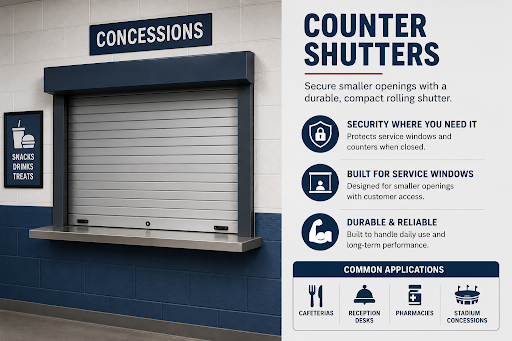
If you’ve ever walked up to a ticket window or concession stand after hours, you’ve probably seen a counter shutter.
These rolling shutters are designed for smaller openings where employees serve customers through a counter or service window. Instead of securing an entire doorway, they protect a specific access point when the area is closed.
They’re often used in cafeterias, reception desks, pharmacies, stadium concessions, and similar locations where security is needed without installing a full-size door.
Security Grilles
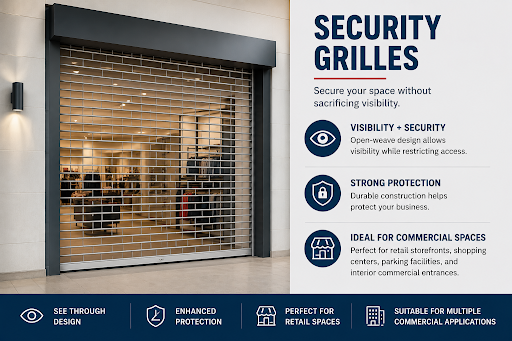
Some businesses want to secure an opening without hiding what’s behind it. Security grilles combine protection with visibility in those cases.
Unlike solid rolling doors, grilles use an open-weave design that allows people to see through the opening while restricting access.
They are often installed in retail storefronts, shopping centers, parking facilities, and interior commercial entrances.
How to Choose the Right Roll-Up Door for Your Building
Not every roll-up door is built for the same job.
A self-storage facility, warehouse, retail storefront, and concession stand all have different requirements.
Some buildings need better security. Others need insulation, fire protection, or a door that can handle frequent daily use.
When comparing different types of commercial roll-up doors, start by looking at how the opening will be used.
Traffic levels, environmental conditions, available space, and code requirements can all affect which door makes sense for the building.
Roll-Up Door Comparison Chart
| Type | Best for | Material | Typical Lead Time |
| Rolling Service Door | Warehouse, industrial buildings | Steel or aluminium slats | 4-12 weeks |
| Roll-Up Sheet Door | Storage units, sheds | Corrugated steels | 2-8 weeks |
| Insulated Rolling Door | Climate-controlled facilities | Insulated steels slats | 4-12 weeks |
| Fire-rated Door | Code-required openings | Fine-rated steel | 6-12 weeks |
| High-Speed Door | Manufacturing logistics | Steel, fabric, hybrid | 4-12 weeks |
| Counter Shutters | Service counters | Aluminium or steel | 3-8 weeks |
| Security Grilles | Storefront securities | Aluminium or steel grille | 4-10 weeks |
A self-storage facility may only need a basic sheet door, while a warehouse loading dock may require a rolling service door designed for frequent daily cycles.
Buildings that need temperature control may benefit from insulated doors, while code-required openings often use fire-rated systems.
Residential vs. Commercial Roll-Up Doors
Roll-up doors aren’t limited to commercial buildings.
They’re often installed on workshops, detached garages, storage buildings, and sheds because they take up very little ceiling space when open. Commercial doors are generally built for larger openings and heavier daily use.
A warehouse door may open dozens of times throughout the day, while a residential door might only be used a few times.
That’s why commercial systems often use heavier materials and components designed for higher cycle counts.
Standard Roll-Up Door Sizes
Standard commercial roll-up door sizes vary widely by their application.
Smaller openings may start around 8 feet wide, while warehouse and loading dock doors can exceed 20 feet in width.
Common commercial sizes include:
- 10′ x 10′
- 10′ x 12′
- 12′ x 12′
- 12′ x 14′
- 14′ x 14′
- 16′ x 16′
There are custom sizes also available for specialized facilities.
Roll-Up Door Cost Guide
A common question building owners ask is how much a 12′ x 14′ roll-up door costs.
Pricing for a door of this size can vary widely depending on the type of system selected. A basic sheet door typically sits at the lower end of the cost spectrum, while heavy-duty rolling service doors, insulated models, or fire-rated systems fall into a higher range due to their added materials and engineering requirements.
The final cost depends on the type of door, its size, and any additional features included with the system. A basic sheet door generally costs less than an insulated or fire-rated model of the same size, and adding a motor operator, access controls, or specialty features can further influence the price.
Factors that affect cost include:
- Door size
- Material
- Insulation
- Fire-rating requirements
- Operator systems
- Access controls
- Installation conditions
Because every opening is different, pricing can vary considerably from one project to another. A quote tailored to the specific project is the most reliable way to get an accurate cost picture.
Rolling Door vs. Coiling Door: What’s the Difference?
In many cases, there isn’t much difference.
Both rolling doors and coiling doors open upward and wrap around a drum mounted above the opening.
Some manufacturers use “coiling door” as a broad category that includes rolling service doors, security grilles, shutters, and specialty products. Others use the terms interchangeably.
In practical use, the difference is often based on the manufacturer’s terminology rather than the function.
Roll-Up Doors vs. Other Garage Door Types
Roll-up doors are one option among several overhead door styles.
A sectional garage door uses multiple panels that travel along overhead tracks. Side-hinged doors swing open like traditional doors, while sliding doors move horizontally along a track.
The main advantage of a roll-up door is that it coils into a compact roll above the opening.
This can be useful in buildings where ceiling space is limited or where the door will be used frequently throughout the day.
The best door style depends on the building layout, available headroom, and how often the opening is used.
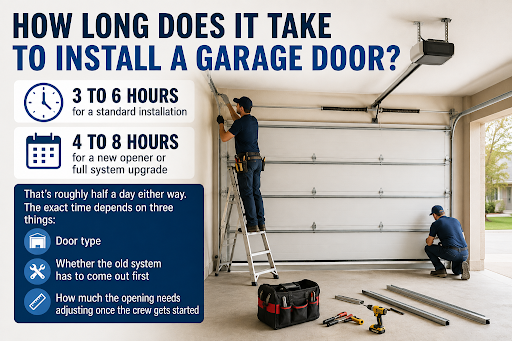
Roll-Up Garage Door Installation
A roll-up door relies on proper alignment to operate smoothly.
During installation, the opening is measured, guide tracks are mounted, and the curtain assembly is positioned above the doorway.
The door must be balanced correctly so it opens and closes without placing unnecessary strain on the operating system.
Installation requirements vary based on door size, mounting conditions, and whether the system includes a motor operator.
If the tracks are not aligned correctly or the door is not balanced properly, the system may not operate smoothly, and additional strain can be placed on the operator.
Roll-Up Door Service & Repair
Like any mechanical system, rolling doors experience wear over time.
Daily use can affect springs, tracks, operators, and other moving parts. A damaged slat or misaligned guide can also prevent the door from operating properly.
Common repair issues include:
- Damaged slats
- Worn springs
- Track alignment problems
- Operator malfunctions
- Sensor issues
- Impact damage
A damaged slat, worn spring, or track issue can become a larger repair if left
unaddressed.
Get a Quote on a Commercial Roll-Up Door
Choosing a roll-up door starts with understanding the building’s needs.
Door size, traffic levels, insulation requirements, and security considerations all play a role in selecting the right system.
If you’re planning a new installation or replacing an existing rolling door, North Country Overhead Door can help you evaluate door options based on your building requirements.
Frequently Asked Questions
Q1. What are the main types of roll-up doors?
The main types are rolling service doors, roll-up sheet doors, insulated rolling doors, fire-rated rolling doors, high-speed doors, counter shutters, and security grilles.
Q2. What is the difference between a rolling door and a coiling door?
In many cases, there is no functional difference. Both open vertically and wrap around a drum above the opening. The terms are often used interchangeably.
Q3. Are roll-up doors good for residential use?
Yes. Roll-up doors are commonly used on detached garages, workshops, storage buildings, and sheds where space efficiency is important.
Q4. What are the 8 or 5 types of garage doors?
Common garage door categories include roll-up doors, sectional doors, side-hinged doors, sliding doors, swing doors, folding doors, carriage-style doors, and specialty commercial doors.